DISCOVER HURGHADA • HISTORY & CULTURE
The History of Hurghada – From Fishing Village to Red Sea Resort City
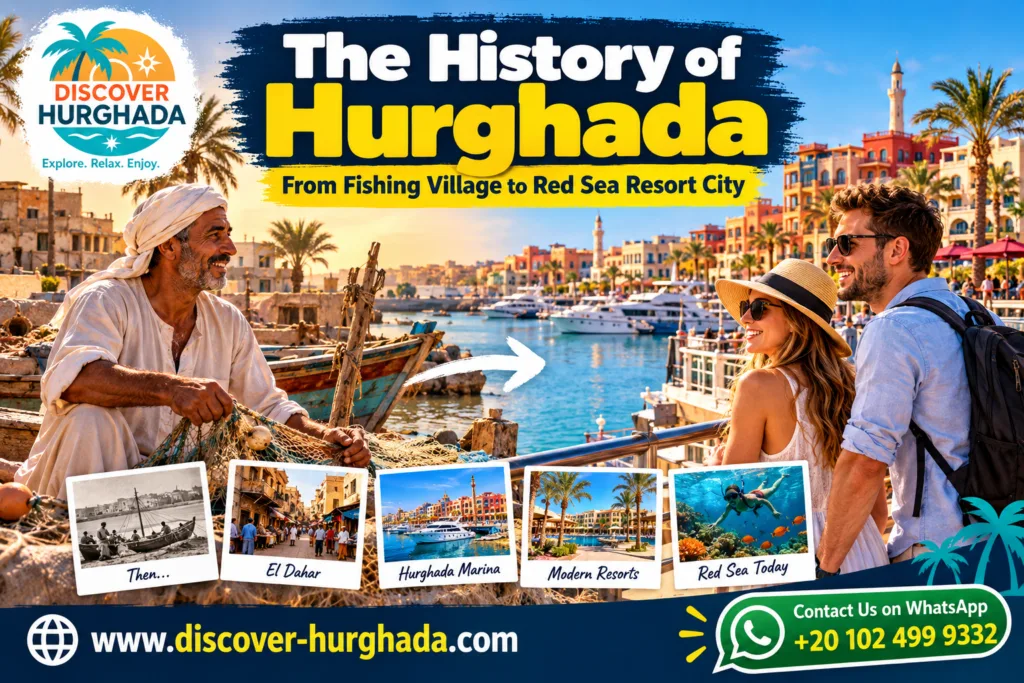
The history of Hurghada tells the story of a small Red Sea coastal settlement that gradually developed into one of Egypt’s most recognizable holiday destinations.
Long before international resorts, diving centers and busy marinas shaped the coastline, the area was associated with fishing communities, maritime life and the natural resources of the Egyptian Red Sea.
During the twentieth century, petroleum activity, improving infrastructure and eventually large-scale tourism investment contributed to a remarkable transformation.
Today, Hurghada combines older neighborhoods, local markets, modern residential districts, beachfront hotels and a growing international community. Understanding this evolution reveals a side of the city that goes far beyond its beaches.
Explore Hurghada’s past, discover its changing identity and learn where visitors can still experience elements of local Red Sea culture.
Quick Answer: What Is the History of Hurghada?
The history of Hurghada is closely connected to fishing, Red Sea coastal life, petroleum development and modern tourism. The area was once a relatively small settlement rather than the extensive resort city visitors know today.
During the twentieth century, industrial activity and improved connections contributed to local development. From the late twentieth century onward, international interest in the Red Sea’s coral reefs, beaches and diving opportunities encouraged tourism investment.
Hotels, roads, airport services, restaurants and resort developments expanded over subsequent decades. Hurghada gradually became a major international tourism destination while also growing as a place where Egyptians and foreign residents live and work.
Today, El Dahar offers a glimpse of the city’s older urban character, while areas such as Sekalla, the Marina and newer coastal resorts illustrate its transformation.
Introduction: Understanding Hurghada Beyond the Beaches
For many international visitors, Hurghada means warm weather, snorkeling, coral reefs and all-inclusive resorts. Yet the city’s identity is more complex than its holiday image.
Hurghada has experienced major changes in population, employment, architecture and daily life. The city that once depended on comparatively limited coastal and industrial activities now supports a broad network of hotels, transport businesses, restaurants, tour providers, shops and residential services.
This growth did not happen overnight. It developed through several overlapping stages, and different neighborhoods still reflect different periods of the city’s expansion.
Understanding the history of Hurghada also helps visitors appreciate the relationship between tourism and local communities. Behind the hotels are generations of Egyptian workers, fishermen, business owners and families who contributed to the city’s development.
For an introduction to the destination today, explore the Hurghada Travel Guide and our Hurghada A–Z Guide.

Table of Contents – History of Hurghada
- Why Hurghada’s Location Matters
- Hurghada Before Tourism
- The Origin of the Name Hurghada
- Petroleum and Early Development
- The Beginning of Tourism
- The Rise of Red Sea Diving
- Expansion During the 1980s and 1990s
- El Dahar and Old Hurghada
- Sekalla and Hurghada Marina
- The Development of Resort Areas
- How Tourism Changed Local Life
- Historical Timeline
- Hurghada Then vs Now
- What Remains of Traditional Hurghada?
- Places to Explore Hurghada’s History
- Hurghada’s Future and Identity
- Discover Hurghada Experiences
- Final Answer
- Frequently Asked Questions
Why Hurghada’s Location Shaped Its History
Hurghada lies on Egypt’s western Red Sea coast, in the Red Sea Governorate. Its location helped determine both its early economic activities and its eventual emergence as a tourism destination.
The surrounding region combines desert landscapes, coastal waters, offshore islands and coral reef ecosystems. These natural characteristics influenced how people used the coastline long before large hotels were constructed.
For fishing communities, access to marine resources provided an important livelihood. For later tourism developers, the same waters offered opportunities for swimming, diving, snorkeling and boat excursions.
The Red Sea as a Natural Resource
The Red Sea supports diverse marine ecosystems, including coral reefs and numerous fish species. Its warm-water environment and underwater scenery became important reasons for the growth of recreational diving.
However, the value of the sea is not limited to tourism. Fishing, shipping, coastal settlement and regional trade have all played roles in the wider history of Egypt’s Red Sea coast.
Desert and Coastline Together
Hurghada’s desert surroundings also influenced the city’s development. Modern infrastructure had to support growing demand for water, electricity, roads and public services in an arid coastal environment.
Today, this contrast between sea and desert remains a defining part of Hurghada’s landscape and visitor experience.
Hurghada Before Tourism: A Small Red Sea Fishing Community
Before Hurghada became an international holiday destination, the settlement was much smaller and its economy was far less diversified.
Fishing is central to the city’s commonly described early history. Coastal communities relied on practical knowledge of the sea, weather, boats and seasonal marine conditions.
Traditional fishing required patience, local experience and cooperation. Fishermen needed to understand where fish were likely to be found, when conditions were suitable for sailing and how to maintain their equipment.
What Was Daily Life Like?
Life in a small coastal settlement was very different from the pace of modern resort tourism. There were fewer large commercial developments, fewer services and a much smaller built-up area.
Families depended on local economic opportunities, while access to goods and services was more limited than it is today.
Rather than a continuous line of hotels and beach clubs, much of the coastline remained comparatively undeveloped.
Fishing Boats and Local Knowledge
Small boats and traditional fishing practices formed part of coastal life. Skills were learned through experience, including navigation, net handling, equipment maintenance and understanding changing sea conditions.
Fishing also created social connections through markets, boat maintenance and the distribution of seafood.
Did Fishing Disappear When Tourism Arrived?
No. Fishing remains part of Hurghada’s local identity, although the modern city’s economy is much more varied.
Visitors can still encounter seafood markets, working boats and restaurants serving fish and other seafood. These activities provide a reminder that Hurghada’s relationship with the Red Sea existed before leisure tourism.
Where Does the Name Hurghada Come From?
The origin of the name Hurghada is a frequently asked question, but explanations found in popular travel writing are not always supported by clearly identified historical records.
One commonly repeated local explanation connects the name with a desert plant known in Arabic by a similar-sounding name. Other accounts discuss the name’s relationship to the area’s earlier landscape and settlement.
These explanations should be treated as local etymological traditions unless supported by reliable linguistic or historical documentation.
Why Are There Different Spellings?
The city’s Arabic name is الغردقة. In English, Hurghada is the standard spelling used by most international travel websites and airlines.
Alternative transliterations sometimes appear because Arabic sounds do not always map directly onto English letters.
Was Hurghada Founded in a Specific Year?
Many tourism websites assign an exact year to Hurghada’s foundation, often linking the date to the development of petroleum activity. However, the beginning of a settlement, the growth of an industrial base and formal administrative recognition are different historical events.
Without a clearly documented official record, it is more accurate to describe Hurghada’s early twentieth-century development than to present a single founding date as undisputed fact.
Petroleum and the Early Twentieth-Century Development of Hurghada
Petroleum exploration and industrial activity formed another important part of Hurghada’s modern development.
During the twentieth century, oil-related operations expanded in parts of Egypt’s Red Sea region. This created demand for workers, transport links, accommodation and supporting services.
Although Hurghada is now internationally associated with tourism, its history also reflects the broader economic importance of energy resources along Egypt’s Red Sea coast.
How Did Industrial Activity Affect the Settlement?
Industrial operations can create employment opportunities and encourage improvements in infrastructure. Workers need housing, supplies and transport, while businesses develop to support everyday needs.
In Hurghada, this contributed to the transition from a relatively small coastal community toward a more complex urban settlement.
Why Is This Period Often Overlooked?
Tourism marketing naturally focuses on beaches, diving and hotels. As a result, the industrial history of the area receives less attention in many visitor guides.
Yet the petroleum period is relevant because Hurghada’s transformation did not begin with tourism alone. Earlier economic activities and infrastructure helped shape the conditions in which later growth became possible.
How Did Tourism Begin in Hurghada?
The development of tourism in Hurghada was closely linked to the Red Sea’s natural attractions.
Its clear waters, coral reefs, warm climate and coastal scenery appealed to travelers interested in diving and beach holidays. As Egypt’s international tourism industry expanded, Hurghada became increasingly attractive to investors and holiday operators.
Early visitors did not encounter the extensive tourism infrastructure available today. Accommodation choices were more limited, and many coastal locations had not yet been developed into organized resorts.
From Specialist Travel to Mainstream Holidays
Recreational divers and visitors interested in the Red Sea’s marine environment helped build awareness of the destination.
Over time, Hurghada became attractive to a much broader market, including families, couples, group travelers and visitors looking for affordable sunshine holidays.
This transition increased demand for hotels, restaurants, excursions, transport services and shopping facilities.
Why Did International Tourists Choose Hurghada?
- Access to coral reefs and snorkeling locations.
- Warm weather and a long beach holiday season.
- Direct or connecting flights from international markets.
- A growing range of resort accommodation.
- Boat trips, diving and desert excursions.
- Holiday packages combining flights, hotels and transfers.
For visitors planning a trip today, our Best Time to Visit Hurghada guide explains how seasonal conditions affect the holiday experience.
The Rise of Diving and Red Sea Tourism in Hurghada
Diving played a major role in building Hurghada’s international reputation.
The Red Sea’s underwater visibility, coral formations and marine life made the area appealing to recreational divers. As interest grew, diving businesses, training services and organized boat excursions became increasingly important parts of the tourism economy.
Why Were Coral Reefs So Important?
Coral reefs create complex underwater habitats and support a wide variety of marine organisms. For visitors, they offer the opportunity to observe fish, coral structures and other wildlife in a natural environment.
These attractions helped differentiate Hurghada from destinations primarily known for beaches and nightlife.
How Did Diving Support Other Businesses?
A growing diving sector creates demand for boats, equipment, instructors, maintenance services, transportation and hospitality.
Visitors who travel for diving also use hotels, restaurants, shops and other local businesses. In this way, marine tourism contributes to a wider network of employment.
The Importance of Marine Conservation
Tourism growth also creates environmental challenges. Reefs can be affected by physical damage, pollution, poor anchoring practices and broader pressures such as warming seas.
Responsible tourism is therefore essential to protecting the marine ecosystems that helped make Hurghada famous.
Visitors can learn more through our Best Dive Sites in Hurghada, Beginner Diving Guide and Hurghada Eco Trips.
Hurghada’s Transformation During the 1980s and 1990s
The late twentieth century was a decisive period in Hurghada’s development as a resort destination.
During the 1980s and 1990s, tourism investment and the expansion of hotel capacity helped change the scale of the city. New businesses emerged to serve a growing number of domestic and international visitors.
Roads, utilities, accommodation and transport facilities became increasingly important as tourism demand grew.
The Expansion of Hotels and Resorts
Resort construction changed the appearance of the coastline. Areas previously characterized by comparatively limited development gradually became home to larger hospitality complexes and associated services.
Hotels also created jobs in reception, food service, maintenance, housekeeping, administration, entertainment and guest transportation.
The Importance of Air Travel
International air connections supported Hurghada’s transition from a regional coastal settlement into a destination accessible to holidaymakers from numerous countries.
Improved airport capacity and organized holiday packages made it easier for visitors to travel directly to the Red Sea.
For current arrival information, read our Hurghada Airport Arrivals Guide.
Population and Urban Expansion
As tourism and related services expanded, Hurghada attracted people seeking employment and business opportunities.
Residential neighborhoods, local shops, schools and other facilities developed alongside tourism infrastructure. This is one reason modern Hurghada cannot be understood solely as a collection of beach resorts.
El Dahar: Discovering the Older Side of Hurghada
El Dahar, often called Old Hurghada, is one of the most useful places for visitors who want to see a different side of the city.
Compared with many purpose-built resort environments, El Dahar has a more traditional urban character, with residential streets, markets, shops and local services.
It is not an untouched historical village, and its buildings and businesses have changed over time. Nevertheless, the district offers valuable insight into everyday Egyptian city life beyond the beachfront hotel zones.
Local Markets and Shopping Streets
Walking through commercial areas of El Dahar introduces visitors to ordinary retail activity, including food shops, household businesses and markets serving residents.
The experience can be very different from shopping inside resort complexes, where businesses often focus primarily on tourists.
Traditional Food and Local Restaurants
Egyptian food is another accessible way to experience local culture. Dishes such as foul, taameya, koshari and grilled specialties are part of the wider Egyptian culinary tradition.
Explore our Hurghada Restaurant Guide to discover different dining options across the city.
Respecting the Local Community
When exploring residential areas, dress appropriately for the setting, ask permission before photographing individuals and remember that markets and streets are workplaces and neighborhoods rather than tourist attractions alone.
A respectful approach often makes local exploration more enjoyable for both visitors and residents.
Sekalla, Sheraton Road and the Development of Hurghada Marina
Sekalla represents another important part of Hurghada’s urban evolution.
Over time, commercial streets, tourism businesses, hotels and restaurants contributed to the growth of the central city area.
Sheraton Road became a recognizable commercial corridor for many visitors, with shopping, dining and services aimed at both residents and tourists.
How Did Hurghada Marina Change the Waterfront?
Hurghada Marina reflects a more contemporary phase of waterfront development, with leisure facilities, restaurants, boat services and pedestrian areas.
It offers a contrast with older working coastal environments and demonstrates how parts of the city’s shoreline have been adapted for recreation and tourism.
Read our Hurghada Marina Guide for more information.
Does Modern Development Replace Local Identity?
Urban change does not have a single effect. New developments can create jobs and services, but they may also alter the character of established neighborhoods and increase pressure on infrastructure.
Hurghada’s identity continues to be shaped by this relationship between local life, tourism investment and the changing coastline.
The Development of Modern Resort Areas Around Hurghada
As demand for Red Sea holidays increased, tourism development extended beyond the older central districts.
Different coastal areas developed their own identities, accommodation styles and visitor markets.
El Gouna
El Gouna developed as a planned resort town north of Hurghada, with lagoons, marinas, hotels, residential neighborhoods and leisure facilities. It represents a distinctive model of modern Red Sea resort planning.
Sahl Hasheesh
Sahl Hasheesh became known for beachfront resorts, planned developments and an environment focused on holiday accommodation and coastal leisure.
Makadi Bay
Makadi Bay developed as a major resort area south of central Hurghada, attracting visitors interested in beach holidays, snorkeling and hotel-based activities.
Soma Bay
Soma Bay offers another example of coastal resort development in the wider Red Sea region, with hospitality, water sports and recreational facilities.
These developments illustrate how the wider Hurghada tourism region expanded beyond the boundaries of the original urban settlement.
Visitors deciding where to stay should consider whether they prefer access to city life or a more self-contained resort environment.
Our Where to Stay in Hurghada guide compares accommodation areas and their different advantages.
How Tourism Changed Hurghada’s Economy and Local Communities
The growth of tourism transformed the range of economic opportunities available in Hurghada.
While fishing and industrial activities remain relevant to the city’s history, hospitality and related services now form a major part of its economic identity.
Employment Opportunities
Tourism supports a wide variety of occupations, including hotel staff, restaurant workers, guides, diving instructors, drivers, boat crews, maintenance teams and retail employees.
It also creates opportunities for suppliers and service businesses that may not interact directly with tourists.
Growth of Small Businesses
Restaurants, cafés, shops, travel services and professional businesses developed to meet the needs of residents and visitors.
This commercial growth contributes to the diverse business environment visible across modern Hurghada.
Discover local services through the Discover Hurghada Business Directory.
Housing and Residential Life
As more people moved to Hurghada for work and business, demand for residential accommodation increased.
Different neighborhoods emerged or expanded to serve families, employees, business owners and international residents.
For a modern perspective, explore Best Areas to Live in Hurghada for Expats.
Challenges of Rapid Growth
Rapid urban and tourism development can also create challenges involving water consumption, waste management, coastal protection, traffic and the preservation of local character.
Hurghada’s long-term success depends partly on balancing economic opportunity with environmental responsibility and the needs of its communities.
History of Hurghada Timeline – Key Stages of Development
The following timeline summarizes the broad stages of Hurghada’s evolution. It is intended as an accessible overview rather than a definitive chronology of every administrative or construction milestone.
Before Large-Scale Modern Development
The coastal area supported relatively small-scale settlement and activities associated with the Red Sea, including fishing.
Early Twentieth Century
Petroleum exploration and related economic activity became important elements of the wider region’s development.
Mid-Twentieth Century
The settlement continued developing, with local communities and infrastructure supporting economic activity.
1970s–1980s
Interest in Red Sea tourism and diving expanded, creating opportunities for accommodation and visitor services.
1990s
Resort development and tourism-related infrastructure grew, helping Hurghada reach broader international holiday markets.
2000s
Further hotel construction, residential growth and commercial expansion changed the city’s scale and appearance.
2010s–2020s
Hurghada continued evolving as a major Red Sea tourism destination with residential communities, local businesses and modern visitor services.
Hurghada Then vs Now – How Has the City Changed?
Comparing Hurghada’s earlier character with the modern destination helps illustrate the scale of its transformation.
| Feature | Earlier Hurghada | Modern Hurghada |
|---|---|---|
| Main economic activities | Fishing, local trade and industrial activity | Tourism, hospitality, services, retail and other industries |
| Urban development | Smaller coastal settlement | Extensive city districts and resort areas |
| Accommodation | Limited visitor infrastructure | Hotels, resorts, apartments and residential compounds |
| Transportation | More limited regional connections | Airport links, roads, taxis and organized transfers |
| Waterfront | Fishing and relatively undeveloped coastal areas | Marinas, beaches, resorts and working marine facilities |
| Employment | Smaller range of local industries | Broad hospitality and service economy |
| International profile | Relatively limited tourism recognition | Established international Red Sea holiday destination |
| Community | Smaller local settlement | Larger and more diverse residential population |
The comparison is necessarily simplified. Hurghada has never been defined by only one occupation, and modern fishing and industrial activities have not entirely disappeared.
What Remains of Traditional Hurghada Today?
Despite major urban expansion, visitors can still encounter aspects of Hurghada’s older local character.
Working Fishing Boats
Fishing activity remains a visible reminder of the city’s maritime heritage. The working waterfront should be approached respectfully, with attention to local access rules and the safety of boat crews.
Local Food Markets
Markets provide a window into everyday commercial life. Fish, vegetables, spices and household goods reflect the practical needs of local communities.
Older Residential Districts
Neighborhoods such as El Dahar differ from purpose-built holiday resorts. Their streets and businesses reveal how the city functions beyond tourism.
Egyptian Food and Social Traditions
Local cafés, bakeries and restaurants preserve familiar aspects of Egyptian food culture, even as international dining options continue to expand.
Marine Knowledge and Boat Work
Boat maintenance, navigation and experience of Red Sea conditions remain important skills in fishing, diving and tourism-related maritime activities.
These connections show that Hurghada’s past is not confined to museums or historical photographs. Elements of its maritime and community traditions remain part of everyday life.
Where Can Visitors Explore Hurghada’s History and Culture?
Hurghada is not primarily an ancient archaeological city like Luxor. Its historical appeal is more closely connected to local coastal life, urban development and the contrast between older neighborhoods and modern tourism areas.
1. El Dahar Old Town
Explore traditional commercial streets, local shops and markets. This is one of the most accessible ways to observe a side of Hurghada that differs from resort-centered tourism.
2. Local Fish Markets and Working Waterfront Areas
Where public access is permitted, visitors can observe parts of the city’s continuing connection to fishing and maritime activity.
3. Hurghada Marina
The marina offers a contrasting view of contemporary waterfront development, with leisure facilities and organized boat services.
Read the Hurghada Marina Guide.
4. Hurghada Museum
Hurghada Museum provides an opportunity to engage with Egyptian history and cultural heritage through its collections. It is important to distinguish the museum’s broader Egyptian historical exhibits from objects specifically documenting Hurghada’s own urban development.
Check current opening hours and ticket information through official channels before visiting.
5. The Red Sea Coast and Giftun Islands
Boat trips offer a different perspective on the coastline and the marine environment that helped shape the city’s economic and tourism history.
Visitors should choose responsible operators and avoid activities that damage reefs or disturb wildlife.
6. A Cultural Excursion to Luxor
Travelers interested in ancient Egyptian civilization can also consider an excursion to Luxor. Although Luxor is not part of Hurghada’s local history, it offers a valuable opportunity to explore a very different historical landscape.
The Future of Hurghada: Growth, Sustainability and Local Identity
Hurghada’s transformation is still continuing. Tourism remains an important economic driver, while residential development, services and local entrepreneurship continue shaping the city.
Future growth brings opportunities but also questions about environmental protection, infrastructure and the preservation of community character.
Protecting the Red Sea
The health of coral reefs and marine ecosystems is essential to the region’s environmental value and tourism appeal.
Responsible boat operations, waste management and reef protection are important for the long-term sustainability of the destination.
Supporting Local Businesses
Tourism benefits can extend beyond large hotels when visitors also use independent restaurants, shops, guides and local services.
Supporting reputable local businesses helps connect the visitor economy with the wider community.
Preserving the City’s Identity
Hurghada’s history deserves recognition alongside its modern attractions. Fishing traditions, working neighborhoods and the stories of local residents form part of the city’s cultural identity.
Understanding these connections can encourage a more thoughtful approach to tourism, one that values the destination as a living city rather than only a holiday product.
DISCOVER HURGHADA • EXPLORE THE RED SEA
Discover Hurghada – Experience the City Beyond Its History
Hurghada’s transformation from a small coastal settlement into a major tourism destination is closely connected to the experiences travelers enjoy today.
From island snorkeling to private boats and cultural excursions, Discover Hurghada helps visitors explore the Red Sea region through useful travel guides and available tour options.
🏝️ Orange Bay Snorkeling Trip
Explore one of the best-known island excursion experiences near Hurghada. Enjoy Red Sea scenery, beach relaxation and opportunities to snorkel around marine environments that helped make the region internationally famous.
Review the itinerary, transport arrangements, equipment and inclusions before booking.
🌴 Paradise Island Hurghada
Discover an island-focused boat excursion combining coastal views, beach time and relaxation.
A suitable choice for travelers who want to experience the modern leisure activities that developed alongside Hurghada’s tourism industry.
🐬 Dolphin House Snorkeling
Discover a marine excursion associated with reef snorkeling and the possibility of observing dolphins in the wild.
Choose responsible operators, respect wildlife and remember that sightings cannot be guaranteed.
🚤 Private Speedboat Experience
Enjoy a more personalized way to explore the Red Sea coastline and surrounding marine attractions.
Private trips can offer additional flexibility, subject to operator arrangements, sea conditions and safety requirements.
🏜️ Hurghada Desert Safari
Discover the desert landscapes surrounding the coastal city through an organized excursion.
Compare safari programs and check the vehicle type, age restrictions, safety equipment and included activities.
🏛️ Private Luxor Tour from Hurghada
Explore ancient Egyptian history with a journey from Hurghada to Luxor, home to remarkable temples and archaeological sites.
This excursion complements the story of modern Hurghada by introducing visitors to Egypt’s much older historical heritage.
Plan Your Hurghada Experiences
Whether you prefer island relaxation, snorkeling, a private boat or an excursion to Luxor, contact Discover Hurghada to ask about available experiences, itineraries and booking arrangements.
Final Answer: How Did Hurghada Become a Red Sea Resort City?
The history of Hurghada is a story of gradual economic and urban transformation.
What began as a comparatively small Red Sea coastal settlement developed through fishing, industrial activity, expanding infrastructure and the growing importance of tourism.
The region’s coral reefs, warm climate and coastal scenery attracted visitors, while investment in hotels, transportation and tourism services supported further growth.
Over time, Hurghada evolved into a major resort destination and a much larger city with residential neighborhoods, businesses and communities extending beyond the traditional holiday industry.
Today, the contrast between El Dahar, Sekalla, Hurghada Marina and the modern resort developments provides a visible reminder of that transformation.
Hurghada’s history is therefore not only about how tourists discovered the Red Sea. It is also about how local people, workers, businesses and communities adapted as the city changed.
Discover Hurghada – More Than a Holiday Destination
At Discover Hurghada, we believe that understanding a destination makes visiting it more rewarding.
Our platform brings together travel guides, excursions, local business information, accommodation advice and practical resources to help visitors explore Hurghada and the wider Red Sea region.
Whether you want to discover traditional neighborhoods, plan an island trip, learn about diving or find useful local services, our guides help connect the modern holiday experience with the character of the city itself.
Explore the Hurghada Travel Guide, discover the Hurghada Business Directory and learn more About Discover Hurghada.
Discover Hurghada – Explore. Relax. Enjoy.
Frequently Asked Questions About the History of Hurghada
What is the history of Hurghada?
Hurghada developed from a relatively small Red Sea coastal settlement associated with fishing and later industrial activity into a major tourism destination. Diving, hotels, transport infrastructure and resort investment helped drive its growth during the late twentieth century.
Was Hurghada originally a fishing village?
Hurghada is commonly described as having developed from a small fishing community. Fishing remains an important part of its local maritime heritage, although the modern city has a much broader economy.
When was Hurghada founded?
Hurghada’s development is often associated with the early twentieth century, but published accounts differ about its precise founding date. The establishment of a settlement, industrial development and administrative recognition should not be treated as identical events.
What does the name Hurghada mean?
One commonly repeated local explanation connects the name Hurghada with a desert plant. However, the exact etymology should be treated cautiously unless supported by reliable historical or linguistic sources.
When did tourism begin in Hurghada?
Hurghada’s tourism industry expanded significantly during the late twentieth century, particularly as interest in Red Sea diving and resort holidays increased during the 1970s, 1980s and 1990s.
How did Hurghada become a resort city?
The city’s natural marine attractions encouraged diving and beach tourism. Investment in hotels, infrastructure, air travel and visitor services gradually transformed Hurghada into an internationally recognized holiday destination.
What was Hurghada like before tourism?
Before large-scale resort development, Hurghada was a much smaller coastal settlement with fishing and industrial activities, limited visitor infrastructure and comparatively undeveloped stretches of shoreline.
Which is the oldest part of Hurghada?
El Dahar is commonly known as Old Hurghada and is associated with the city’s older urban character. It contains residential areas, local markets and businesses serving the wider community.
What role did the oil industry play in Hurghada?
Petroleum exploration and related industrial operations formed part of the area’s twentieth-century development, supporting employment and infrastructure before tourism became the city’s dominant international identity.
Is there anything historical to see in Hurghada?
Visitors can explore El Dahar, local markets, working waterfront areas and Hurghada Museum. The city is better known for its modern coastal and tourism history than for extensive ancient archaeological monuments.
How has Hurghada changed over time?
Hurghada has expanded from a small coastal settlement into a major city with hotels, resorts, residential neighborhoods, commercial districts, transport infrastructure and an international tourism economy.
Why did Hurghada become famous for diving?
The Red Sea’s coral reefs, marine life and underwater scenery attracted recreational divers. Diving businesses and organized boat excursions helped establish Hurghada’s reputation as a marine tourism destination.
Explore the Past. Discover the Present. Experience Hurghada.
From its fishing heritage and older neighborhoods to modern Red Sea resorts, Hurghada offers more than a beach holiday. Discover local culture, explore the coastline and plan memorable experiences with Discover Hurghada.
🌍 Visit Discover Hurghada 📲 Contact Us on WhatsApp
www.discover-hurghada.com
Travel Guide • Tours • Business Directory
Discover Hurghada – Explore. Relax. Enjoy.